How do I recognize ion source contamination and what should I clean first?
Learn how to identify ion source contamination in LC-MS systems and which components should be cleaned first.
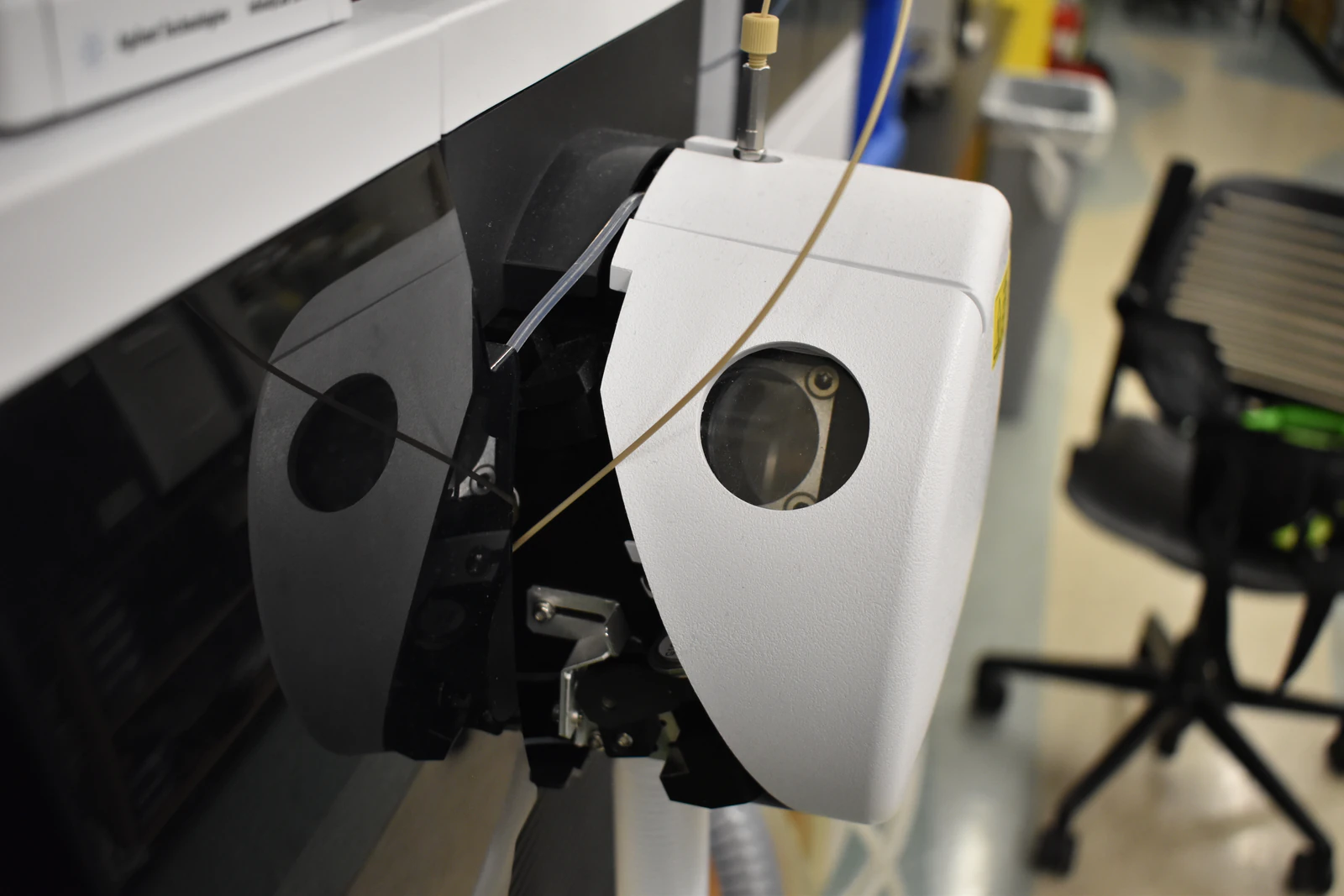
If your tune mix or system suitability signal has dropped by >50% while vacuum, detector baseline, and chromatography look normal, ion source contamination is the most likely first suspect. This guide shows you how to confirm the diagnosis quickly and then clean the highest-impact parts first (ESI/APCI/APPI and EI/CI).
What Ion Source Contamination Looks Like in Real LC–MS and GC–MS Data
1) Sensitivity Loss (Standards Drop, Method Otherwise Looks “Normal”)
Tune mixes and system suitability standards show lower intensity even though:
Vacuum readbacks are stable
Chromatography (retention/peak shape) is largely unchangedESI charge-state distribution shifts: fewer multiply-charged ions than expected
2) Elevated Chemical Background in Blanks
Persistent baseline elevation in solvent blanks and post-column solvent runs
Broad contaminant fingerprints, including:
~44 Da spacing (commonly consistent with PEG/PPG-like contaminants)
m/z 149 (commonly associated with phthalate-type plasticizers)
Fatty/lipid-type signatures that are often prominent in APCI/APPI
3) Increased Adducts and In-Source Chemistry
Excess Na⁺/K⁺ adducts, clusters, and more complicated spectra than historical
Increased in-source fragmentation at settings that previously produced clean molecular ions
4) Ionization Instability
ESI: intermittent spray, needing unusually high ESI voltage and/or gas flows to remain stable; visible salt crust on the emitter tip (when accessible)
APCI/APPI: brown/charred deposits on vaporizer surfaces or corona needle; erratic discharge behavior
5) Carryover/Ghosting That Persists Beyond Chromatography
Analyte-like signal persists into blanks despite acceptable LC separation—suggesting contamination near the ionization region or transfer path
6) Tune/Calibration Becomes “Hard to Pass”
Tune/calibration failures
Mass shifts or poor peak shapes on reference ions that only “improve” at unusually high lens voltages
7) Visual Cues (When Accessible Under SOP)
Darkened plates, residue on cone/orifice, discoloration of the ion-transfer tube
Particulate deposits on skimmer and proximal lenses
Differentiate Source Contamination From Other Failure Modes
Vacuum / Leak Problems (Not Primarily “Source Dirt”)
Rising foreline or high-vacuum pressures, unstable pump speeds, or leak alarms point to leaks/pumps, not just deposits.
Detector Problems
Noisy electron multiplier baselines, unstable gain, or abnormally high dark counts suggest detector aging rather than source contamination.
Chromatography Problems
Retention shifts, tailing, or significant peak-shape changes usually trace to LC mobile phase/column/inlet issues; cleaning the MS source will not correct these.
Electrical / Heater / Flow Issues
Arcing, heater failures, or unstable gas delivery can mimic contamination symptoms—confirm hardware status before disassembly.
Objective Checks Before You Clean Anything
Run a clean solvent blank and inspect both TIC/BPC and the background spectrum
Example solvent system used in many ESI/APCI contexts: 50:50 water:methanol with a volatile acid modifier (as method-compatible)Inject a known tuning mix / system suitability standard at the usual concentration
Compare absolute intensity and S/N to your historical controlConfirm operating stability at normal settings
You should not need abnormally elevated ESI voltage, drying gas, sheath gas, or temperatures to maintain stable ionizationFor EI/CI (GC–MS): check reference ion responses and filament current at typical emission settings
If these checks point to a chemical-background + sensitivity-loss pattern with otherwise normal instrument health, proceed with source cleaning—starting with the parts that typically produce the biggest recovery.
What to Clean First (Highest-Impact Order by Source Type)
ESI (LC–MS)
Clean in this order (highest impact first):
Sampling cone / orifice plate
Emitter / spray needle tip
Ion-transfer capillary / inlet tube
Skimmer / S-lens / focusing lenses (proximal optics)
Curtain plate / jet disruptor surfaces (if present)
Why this order works: the cone/orifice and transfer capillary are the first “collection points” for salts, polymers, and nonvolatile matrix that directly reduce ion sampling and elevate background.
APCI / APPI (LC–MS)
Clean in this order:
Vaporizer tube / inlet surfaces (burnt deposits elevate background dramatically)
Corona discharge needle (APCI) or lamp window (APPI)
Sampling cone / orifice and proximal optics
EI / CI (GC–MS)
Clean in this order:
Ion source block surfaces (repeller/anode/cathode region as applicable)
Draw-out / entrance lens and slit
Transfer line tip at the source entrance
Filament area inspection (do not abrade; avoid direct immersion)
Cleaning Procedure (General, Vendor-Agnostic and Instrument-Safe)
Safety and Preparation
Wear nitrile gloves and safety glasses; follow your facility lockout and venting procedures.
Use only high-purity solvents; prepare clearly labeled cleaning baths such as:
50:50 water:methanol with a volatile acid modifier for salts/polar films
Isopropanol (IPA) for lipids/nonpolar residues
Acetone optional for stubborn organics (avoid contact with plastics/elastomers if incompatible)Avoid strong acids/bases unless explicitly approved by the manufacturer.
Power Down and Access
Stop acquisition; set flows to zero; route LC to waste as appropriate.
Vent the MS only if required by your manufacturer procedure.
Allow the source and heated components to cool fully.
Mark component orientation; document assembly order to prevent reassembly errors.
Component Cleaning (By Part Category)
Metal Parts (cones, plates, transfer tubes, many lenses)
Soak (commonly 10–30 minutes) in the salts/polar-film bath
Gently wipe with lint-free swabs; avoid scratching smooth surfaces
If lipid residues are suspected, follow with an IPA soak and rinse
Ultrasonicate only parts the vendor permits; keep exposure brief when used
Emitter / Spray Needle
Rinse exterior thoroughly
If internal clog is suspected, flush per SOP or replace disposable tips (when applicable)
APCI Vaporizer / Corona Needle
Remove char and films with IPA and gentle swabbing
Avoid bending or damaging the needle; ensure full dryness before reassembly
EI/CI Source Parts
Remove polymerized films using vendor-approved, non-abrasive methods
Do not immerse filaments; keep solvent away from delicate filament assemblies unless approved
Rinse and Dry
Final rinse with fresh methanol or IPA
Dry with clean nitrogen stream (or equivalent clean gas) to avoid water marks
Ensure complete dryness before reassembly to prevent arcing and unstable ionization
Reassembly and Restart
Reinstall parts in original orientation; torque per manufacturer specification
Restart vacuum; confirm pressures stabilize and perform leak checks where applicable
Warm up heaters and stabilize gas flows and temperatures
Post-Clean Verification (Do Not Skip)
Run a solvent blank to confirm:
Baseline reduction
Disappearance or reduction of contaminant seriesInject tune mix/system suitability standard:
Verify recovery of intensity at normal lens/tune voltages
Confirm mass accuracy and peak shapes for reference ionsConfirm stability:
ESI should hold stable spray current at typical ESI voltage and gas settingsRe-run system suitability and confirm S/N and precision meet historical controls
Prevention Best Practices That Extend Time Between Cleanings
Use volatile buffers appropriate for LC–MS and avoid nonvolatile salts (phosphate/sulfate) in MS workflows.
Use a divert valve to send early salt front and late matrix to waste; introduce only the target window into the MS.
Improve sample cleanup (SPE/filtration/desalting) to reduce matrix load.
Keep desolvation conditions optimized to prevent droplet spitting and condensation.
Maintain high-purity gases and replace filters/traps on schedule.
Trend performance: tune intensities, background fingerprints, and required voltages to detect contamination early.
Troubleshooting Decision Guide (Fast Actions)
Low sensitivity + high background + normal vacuum/detector: clean cone/orifice and transfer capillary first.
Unstable spray or visible salt crust: clean emitter tip, reduce salts/suppressors, improve desalting and divert strategy.
APCI/APPI erratic chemistry: clean vaporizer and corona/lamp surfaces, verify heater and gas flows.
EI reference ions drift + darkened source: clean source block and entrance lens, then verify filament emission settings.
Still poor after a first cleaning pass: inspect LC/GC inlet components (autosampler needle/seat; GC liner/septa), and re-check gas/vacuum health.
Brief Summary
Ion source contamination is most often recognized by large standard/tune response loss, elevated chemical background, increased adducts/clusters, and ionization instability while the rest of the system appears normal. The highest-impact first clean is typically the sampling cone/orifice and transfer capillary (ESI/APCI/APPI) or the source block and entrance lens (EI/CI). Use mild high-purity solvents, gentle cleaning, complete drying, and verify recovery with blanks and tune/suitability standards.