How do I troubleshoot unstable spray or nebulizer issues in ESI?
This guide explains how to diagnose unstable electrospray ionization caused by flow, gas, or solvent-related problems.
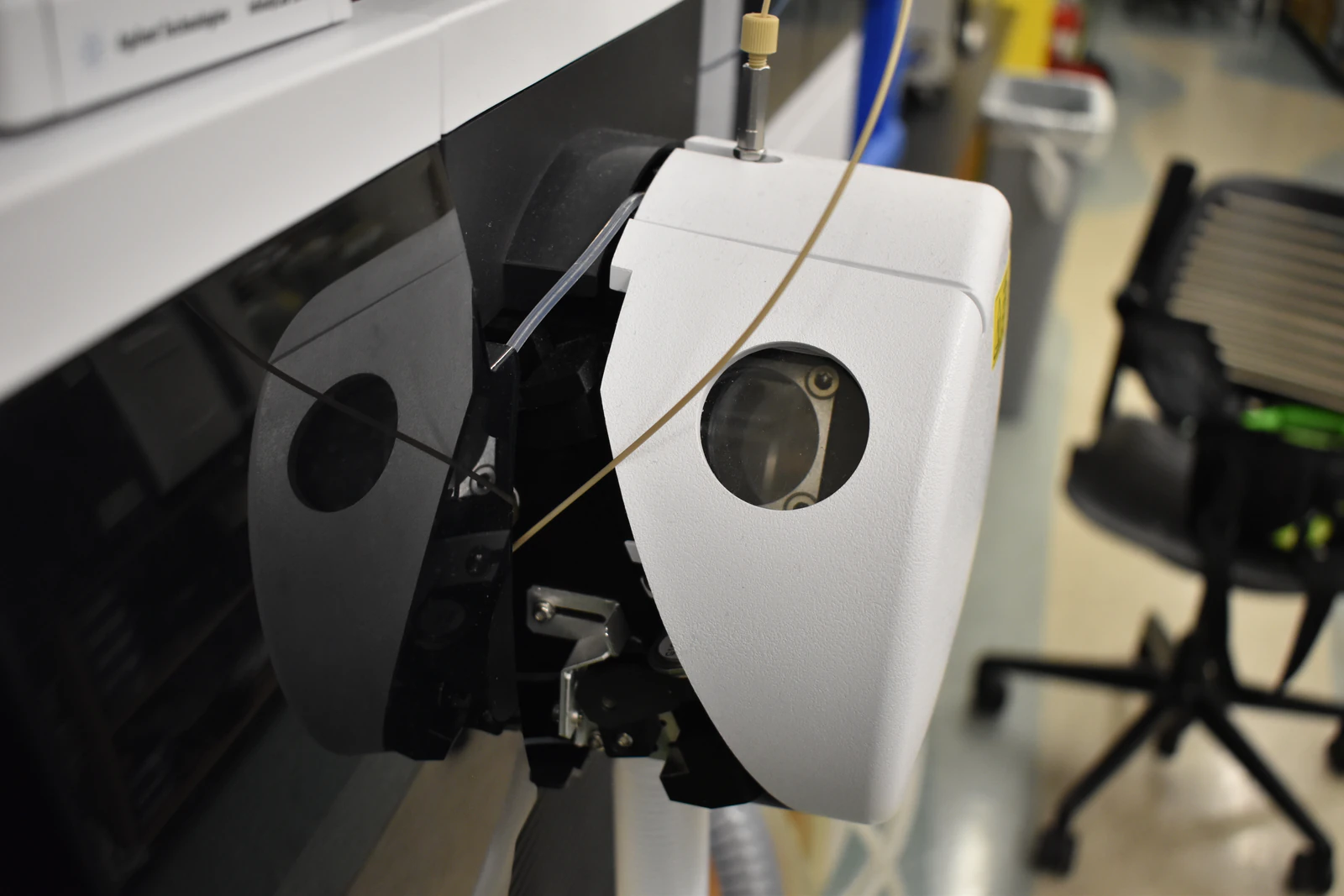
How to Fix TIC Fluctuations, Spray Dropouts, Noise Spikes, and Poor Reproducibility
Electrospray ionization (ESI) stability is a primary driver of LC–MS/MS sensitivity, precision, and spectral cleanliness. When spray becomes unstable, the instrument may still “run,” but data quality deteriorates quickly: signal-to-noise drops, quantitative CVs increase, and method robustness collapses.
An unstable spray typically presents as:
Fluctuating total ion current (TIC) or base peak intensity
Variable charge-state distribution
Intermittent ion signal dropouts
Excessive chemical noise or sporadic spikes
Visible nonuniform spray (no Taylor cone, sputtering, arcing)
The single best indicator of ESI health is a stable Taylor cone, a consistent plume toward the inlet, and a steady spray current.
Safety and Preparation
ESI sources operate at high voltage and use hot gases. Always:
Follow manufacturer lockout procedures before disassembly.
De-energize the source and cool down before cleaning.
Use appropriate PPE and solvent-compatible materials.
Verify nitrogen supply quality and pressure ratings.
Quick Triage Checklist (High-Yield First Checks)
1) Chemistry and Mobile Phase Compatibility
Unstable ESI is often a chemistry problem first and a “hardware problem” second.
Organic %: 30–60% ACN or MeOH with 0.1% formic acid (positive mode) or 2–5 mM ammonium acetate (negative mode).Buffer type: Volatile only (ammonium acetate/formate). Avoid nonvolatile salts (NaCl, KCl, phosphate).Ionic strength: Keep ≤ 5–10 mM total.
Why this matters: high ionic strength and nonvolatile content accelerate salt crusting at the emitter and destabilize droplet formation.
2) Flow and Hydraulics
LC flow: within source spec. Standard ESI ~100–800 µL/min; microflow ~5–50 µL/min; nanoflow ~0.1–1 µL/min.Backpressure/leaks: stable pressure trace; no leaks; proper degassing.
Key indicator: rhythmic TIC oscillations that match pump stroke often point to flow pulsation, bubbles, or cavitation, not to MS electronics.
3) Core Source Parameters
Capillary voltage: +2.5–4.5 kV (positive) or −2.0–−3.5 kV (negative).Nebulizer gas: stable supply; typical 20–50 psi (instrument-dependent).Drying/Sheath gas: adequate, dry, and non-pulsing.Source temp: 250–300 °C (aqueous-rich) up to 350–400 °C (higher organic).
4) Mechanics and Electrical Integrity
Emitter alignment: centered to inlet; tip–orifice distance appropriate (commonly 2–6 mm for standard/microflow).Emitter tip condition: no salt crystals, chips, or clogging.Electrical grounding: LC and source properly grounded; no floating potentials.Observation: no visible corona discharge, sparking, or wetting/flooding of inlet.
What Causes Unstable Spray (Root Causes and Corrective Actions)
Flow Rate Mismatch and Droplet Overloading
Cause: Flow too high for available nebulization/desolvation → wetting and plume instability.
Fixes:
Reduce LC flow or install a post-column split to match source design range.
Increase
drying/sheath gasandsource temperaturewithin safe limits.Increase organic content to lower surface tension and improve droplet breakup.
What to expect when corrected: smoother TIC and reduced wetting of the inlet cone.
Solvent Composition and Matrix Effects
Cause: High salt/ionic strength, nonvolatile buffers, detergents, and high surface tension → erratic spray and rapid deposits.
Fixes:
Replace nonvolatile buffers with ammonium acetate/formate (≤10 mM).
Use
0.1% formic acidin positive mode;2–5 mM ammonium acetateor0.1% NH4OHin negative mode.Increase ACN/MeOH to 30–60% for initial stability checks.
Why this works: it reduces salt crystallization and improves conductivity/surface tension balance that supports Taylor cone formation.
Gas Supply Instabilities (Nebulizer / Drying Gas)
Cause: insufficient pressure, wet gas, or pulsation destabilizes droplet formation.
Fixes:
Verify
nebulizer gaspressure is within spec and stable.Use dry nitrogen; confirm no condensate in lines, traps, or regulators.
Check for leaks, regulator creep, or clogged sintered filters.
Diagnostic hint: if spray stabilizes briefly after regulator adjustments and then degrades again, suspect supply stability or contamination.
Electrical Field Problems: Under-Voltage vs Corona Discharge
Cause:
Overvoltage → corona discharge, arcing, noise spikes
Undervoltage → Taylor cone never forms; sputtering or dripping
Fixes:
Increase
capillary voltagegradually from low values until a cone forms, then optimize for stable current without discharge.Confirm grounding and remove salt crusts that create micro-discharges.
Pattern recognition: audible hiss, visible glow, or sharp TIC spikes commonly indicate discharge rather than chemistry alone.
Emitter Tip Condition and Geometry
Cause: partially clogged, chipped, or asymmetrical tips; salt crystallization at the tip.
Fixes:
Inspect under magnification; clean or replace the emitter.
Rinse tip with
50:50 water:ACN, thenMeOHorIPAas appropriate; avoid harsh acids unless vendor-approved.Do not touch or deform the tip during cleaning.
Why it matters: minor damage changes the local electric field and disrupts stable Taylor cone formation.
Alignment and Tip–Orifice Distance
Cause: off-axis spray or incorrect distance causes droplet loss, wetting, or charge depletion.
Fixes:
Realign sprayer to be coaxial with inlet or per source design (orthogonal for some systems).
Adjust tip–orifice distance: start around
3–5 mmfor standard/microflow, then optimize by TIC stability and absence of wetting.
Rule of thumb: if the inlet is getting wet, increase desolvation and/or adjust distance/flow before increasing voltage.
LC Pump Ripple, Leaks, and Bubbles
Cause: pulsation or micro-leaks induce flow oscillations and unstable plume.
Fixes:
Verify pump seals and check valves; use pulse dampers if available.
Confirm degassing function; purge lines; eliminate compressible bubbles.
Ensure consistent backpressure (healthy column, stable restrictors).
Diagnostic hint: if TIC oscillations are periodic and match the pressure ripple, this is commonly hydraulics-driven instability.
Contamination and Carryover That Destabilize Spray
Cause: sticky compounds, surfactants, or prior matrix residues promote wetting and variable ionization.
Fixes:
Implement strong wash cycles:
IPA → ACN → water (0.1% FA)and repeat as needed.Run a blank gradient to clear memory effects.
Reduce or eliminate surfactants where possible.
Temperature and Desolvation Balance
Cause: insufficient evaporation produces large droplets; excessive heat can increase crusting or degrade thermolabile analytes.
Fixes:
Increase
source tempanddrying gasgradually while monitoring signal and noise.Balance with organic content; avoid overheating and pushing salts to dry out at the tip.
Step-by-Step Troubleshooting Procedure (Reproducible, High-Confidence)
Step 1: Establish a Controlled Baseline
Prepare a simple test solution:
reserpine 100 ng/mLin50:50 ACN:waterwith0.1% FA(positive mode)
orleucine enkephalin 100 ng/mLin50:50 ACN:waterwith5 mM ammonium acetate(negative mode)
Run at a mid-range flow within source specs:
200–300 µL/min(standard ESI) or10–20 µL/min(microflow)
Step 2: Optimize Capillary Voltage for a Stable Taylor Cone
Start low and increase in small steps until TIC smooths and cone stabilizes.
If the spray hisses or glows, back off slightly (discharge regime).
Step 3: Balance Gases and Temperature
Set
nebulizer gasto nominal manufacturer values (e.g.,35–40 psiif applicable).Increase
drying/sheath gasand raisesource tempfrom250 °Cupward as needed to eliminate wetting and ripple.
Step 4: Verify Alignment and Tip Distance
Center emitter and set tip–orifice distance
3–5 mm, then adjust to minimize inlet wetting and maximize TIC stability.
Step 5: Check Hydraulics and Degassing
Confirm stable LC pressure and no leaks.
If instability correlates with gradient changes, evaluate high aqueous segments; consider increasing desolvation capacity during those segments.
Step 6: Clean or Replace the Emitter
Remove salt crust; rinse with appropriate solvents; replace worn/clogged emitters if needed.
Avoid scraping or deforming the tip.
Step 7: Remove Matrix Drivers
Remove nonvolatile buffers and detergents; switch to volatile salts ≤10 mM.
Dilute saline samples or implement trapping/desalting.
Step 8: Monitor Spray Current and TIC
Stable spray current (if available) correlates with stable ESI.
Rhythmic oscillations → hydraulics/pulsation; random spikes → discharge/wetting/contamination.
Step 9: Validate Across a Short Gradient
Once stable in a simple solvent, run a short LC gradient to confirm stability across composition changes.
Mode- and Flow-Specific Notes (ESI Practicalities)
Positive ESI
Use
0.1% formic acidto enhance protonation and reduce surface tension.Watch for corona discharge above ~4.5 kV; reduce voltage or increase organic content.
Negative ESI
Use
ammonium acetate (2–5 mM)or0.1% NH4OH; avoid strong acids.Ensure dry gas to minimize clustering; reduce voltage magnitude if discharge appears.
Nanoflow ESI
Flow stability and bubble elimination are critical.
Tip integrity is non-negotiable; rely on TIC and standards when visual feedback is limited.
Microflow and Standard ESI
Ensure adequate desolvation to prevent inlet wetting.
Use a post-column split when required to stay in the source’s designed range.
Diagnostic Patterns and Targeted Fixes
TIC spikes + audible hiss/glow at tip
Likely corona discharge → reducecapillary voltage, increase organic %, verify grounding, remove deposits.Periodic TIC oscillations synchronized with pump stroke
Pump pulsation/bubbles → service seals/check valves, enable damping, verify degassing and leaks.Stable at high organic, unstable at high aqueous
Desolvation-limited → increase drying gas and temperature; reduce flow during aqueous segments.Signal loss with visible inlet wetting
Droplet overload → reduce flow, increase gas/temp, adjust tip distance.Random dropouts after multiple injections
Tip fouling/salt crust → clean/replace emitter; strengthen wash and reduce nonvolatile load.
Preventive Measures for Stable ESI Performance
Use only volatile mobile phases for ESI methods.
Maintain sufficient organic content during equilibration and wash cycles to avoid wetting.
Inspect and clean emitter and source surfaces routinely.
Keep nitrogen dry; service regulators and filters on schedule.
Log and trend spray current, TIC stability, and source parameters to detect drift early.
Summary
Unstable ESI spray is most commonly caused by a mismatch among flow rate, solvent composition/ionic strength, desolvation capacity, electrical field, and emitter condition/alignment, with additional contributions from LC pump pulsation, bubbles, and contamination. The most reliable approach is to establish a controlled baseline with a simple test solution, then systematically optimize capillary voltage, gases, temperature, alignment, and hydraulics before reintroducing matrix complexity.