
Negative Absorbance in UV-Visible Spectroscopy: Causes and Corrective Actions
Chat with a Chemistry
Expert AI
Ask chemistry questions with confidence. ChemITrust AI Chat combines advanced AI with verified chemical knowledge to provide clear, dependable answers you can trust.
Negative Absorbance in UV-Visible Spectroscopy: Causes, Meaning, and Corrective Actions
UV-Visible spectroscopy is based on the interaction of light with matter, where absorption of photons promotes valence electrons from the ground electronic state to higher-energy excited states. These electronic transitions form the basis for qualitative identification and quantitative determination of chemical and inorganic analytes in solution. When absorbance values become negative, the result is not physically meaningful for a purely absorbing system and must be treated as a diagnostic signal of methodological or instrumental error.
Overview: What Is Negative Absorbance?
In UV-Visible spectroscopy, absorbance is defined as:
A = log₁₀(I₀ / I)
Where:
I₀ = intensity transmitted through the reference (blank)
I = intensity transmitted through the sample
A negative absorbance occurs when:
I > I₀
This means the detector registers more light passing through the sample than through the blank.
Under normal Beer–Lambert conditions, this is nonphysical for a purely absorbing solution. Therefore, negative absorbance in UV-Vis spectroscopy indicates:
Blank mismatch
Optical or detector imbalance
Sample emission or scattering effects
Baseline or data-processing artifacts
Beer–Lambert Law and Linearity Context
UV-Visible spectroscopy in its linear regime follows the Beer–Lambert law:
A = ε · b · c
Where:
ε = molar absorptivity
b = optical path length
c = analyte concentration
If negative absorbance values appear, this signals deviation from expected linear absorbance behavior and must be investigated before reporting quantitative results.
What Negative Absorbance Physically Means
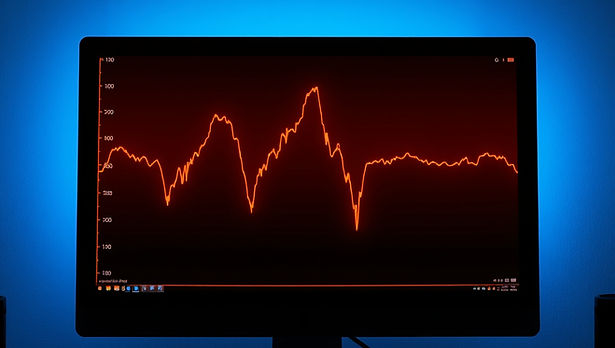
When a UV-Vis spectrum shows a negative region:
Transmittance exceeds 100% relative to the blank baseline.
The blank attenuates light more than the sample.
The sample emits or redirects additional photons into the detector.
The reference channel intensity is artificially suppressed.
Magnitude Interpretation
Small negative values (e.g., −0.001 to −0.01 AU):
Typically baseline noise, minor drift, or imperfect zeroing.Large negative peaks or structured negative bands:
Diagnostic of a specific fault in blank preparation, optics, electronics, or sample behavior.
Root Causes of Negative Absorbance in UV-Vis
1. Reference / Blank Mismatch
This is the most common cause.
Mechanisms
Blank absorbs or scatters more strongly than the sample.
Matrix composition differs (pH, ionic strength, solvent ratio).
Refractive index mismatch between blank and sample.
Blank cuvette scratched or contaminated.
Reagent blank contains higher chromophore concentration than reacted sample.
If the blank depresses I₀, then even a clean sample may produce I > I₀.
2. Instrumental and Optical Path Issues
Double-Beam Spectrophotometers
Reference beam partially blocked or misaligned.
Beam splitter imbalance.
Chopper timing inconsistencies.
Result: artificially low I₀.
Single-Beam Spectrophotometers
Improper Auto-Zero.
Baseline captured with contaminated blank.
Stored baseline reused under different optical settings.
Additional Instrumental Factors
Stray light entering detector preferentially in sample channel.
Dark current instability.
Lamp insufficient warm-up.
Slit width changed between blank and sample measurement.
Detector offset or electronics drift.
All distort the ratio I₀ / I.
3. Sample-Related Causes
Fluorescence or Phosphorescence
If the sample emits light upon UV excitation:
Emitted photons enter detector.
Effective I increases.
Apparent negative absorbance appears.
Scattering and Turbidity
Forward scattering may redirect light toward the detector.
If the blank is clear but the sample scatters light into the detector’s acceptance angle, detected intensity increases.
Temperature Effects
Differences in:
Refractive index
Convection currents
Beam focusing
Can produce small negative baseline offsets.
Chemical Instability
If the sample bleaches or reacts during measurement:
Transmittance increases over time.
Previously acquired baseline becomes invalid.
4. Data Processing and Method Errors
Over-aggressive baseline subtraction
Improper smoothing algorithms
Incorrect path length input
Wavelength calibration drift
Using outdated stored blank spectra
Derivative processing artifacts
Software routines can artificially generate negative absorbance features.
Diagnostic Workflow for Negative Absorbance
Step 1: Verify Instrument Readiness
Allow full lamp warm-up.
Check baseline with empty holder.
Insert matched solvent blank.
Confirm near-zero absorbance in non-absorbing region.
Step 2: Inspect Cuvettes
Use matched path-length cuvettes.
Clean windows thoroughly.
Remove bubbles.
Maintain consistent orientation.
Ensure identical fill levels.
Even slight optical differences can produce measurable offsets.
Step 3: Validate Blank Composition
Blank must contain:
Same solvent
Same buffer
Same reagents
Same pH
Same ionic strength
Except for analyte.
Step 4: Check Optical and Electronic Stability
Verify wavelength accuracy.
Run dilution series for linearity.
Inspect for non-zero intercept.
Evaluate stray light.
Confirm slit width unchanged.
Step 5: Evaluate Sample Behavior
If fluorescence suspected:
Narrow slit bandwidth.
Select alternative analytical wavelength.
Reduce excitation intensity.
If turbidity present:
Filter or centrifuge.
Ensure consistent matrix treatment.
Step 6: Re-Acquire Baseline
Perform fresh Auto-Zero.
Avoid using stored baseline.
Run control standard.
Confirm positive absorbance where expected.
Quality Control Criteria
Baseline Noise and Drift
For routine quantitative work:
Baseline noise ≈ 0.001 AU or lower
Drift ≈ 0.002 AU per hour or lower
Exceeding these indicates instability.
Linearity Check
Confirm Beer–Lambert behavior:
Linear response across concentration range
Intercept near zero
Consistent slope
Negative absorbance may correlate with systematic blank or optical issues.
Summary
Negative absorbance in UV-Visible spectroscopy means the measured transmitted intensity through the sample exceeds that of the blank (I > I₀), resulting in:
A = log₁₀(I₀ / I) < 0
This condition typically arises from:
Improper blank preparation
Optical path imbalance
Detector or electronic instability
Fluorescence or scattering
Data-processing artifacts
A structured troubleshooting workflow restores physically meaningful absorbance values and ensures accurate quantitative analysis under Beer–Lambert conditions.
ChemITrust AI & Lab Services