
UV-Visible Light Sources Explained: Deuterium and Tungsten Lamps in Spectrophotometry

Chat with a Chemistry
Expert AI
Ask chemistry questions with confidence. ChemITrust AI Chat combines advanced AI with verified chemical knowledge to provide clear, dependable answers you can trust.
UV–Visible Light Sources Explained: Deuterium and Tungsten Lamps in Spectrophotometry
Overview
UV–Visible spectrophotometry depends on stable, broadband illumination to quantify absorbance or transmittance across the ultraviolet and visible regions. Modern instruments rely on two complementary lamp technologies:
Deuterium discharge lamps for ultraviolet measurements, providing strong output in the deep-UV through near-UV.
Tungsten-halogen filament lamps for the visible and near-infrared regions, delivering a smooth, thermally generated continuum.
Many spectrophotometers integrate both lamps and automatically transition between them in the near-UV/visible overlap region to maintain continuous spectral coverage with optimal signal quality.
Why Light Source Selection Matters
Lamp choice directly influences analytical performance because the light source governs:
Spectral coverage and usable wavelength range
Intensity stability over short and long timescales
Noise characteristics that limit detection sensitivity
Drift behavior that affects baseline reproducibility
Stray light susceptibility at high absorbance levels
These factors are especially critical for low-absorbance measurements, high-optical-density samples, and UV detectors used in chromatographic workflows where rapid response and baseline stability are essential.
Deuterium Lamps (D₂): Ultraviolet Continuum Sources


Physical Principle and Emission Characteristics
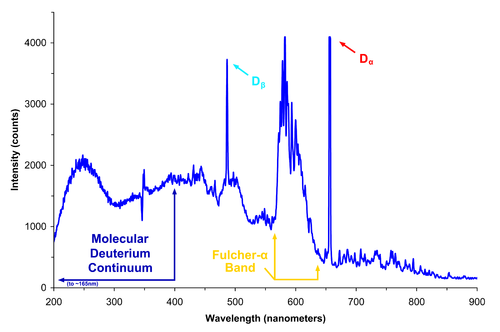
Deuterium lamps operate as low-pressure molecular discharge sources. Electrical excitation of deuterium gas produces a smooth molecular continuum dominated by electronic transitions and radiative recombination processes. This emission provides high radiant intensity across the ultraviolet region, making deuterium lamps the standard choice for UV spectrophotometry.
Output decreases rapidly beyond the near-UV, and discrete spectral features may appear at longer wavelengths. Dual-lamp instruments avoid these regions by switching to an alternative source before visible-region measurements.
Operating Characteristics
Usable range: Approximately 190–400 nm
Warm-up behavior: Requires extended stabilization time for plasma and thermal equilibrium
Operational lifetime: Finite, governed by discharge conditions, power stability, and cycling frequency
Electrical requirements: Stable, well-regulated high-voltage supplies are essential; electrical ripple manifests directly as baseline noise or drift
Strengths
Strong ultraviolet output with a relatively smooth spectral profile
Low short-term intensity fluctuations when driven by properly filtered power supplies
Limitations
Insufficient radiant intensity in the visible region
Gradual intensity loss and baseline curvature as the lamp ages
Tungsten-Halogen Lamps: Visible to Near-Infrared Sources
Physical Principle and Emission Characteristics
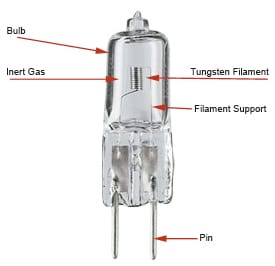
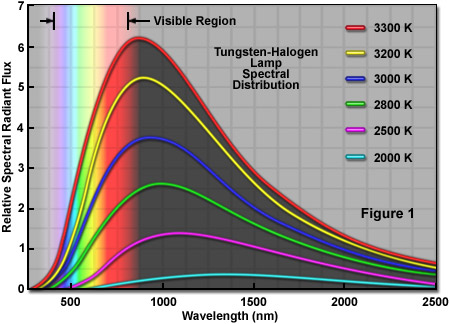
Tungsten-halogen lamps generate light by resistive heating of a tungsten filament enclosed in a halogen atmosphere. The halogen cycle redeposits evaporated tungsten onto the filament, limiting envelope darkening and extending usable lifetime. The emitted spectrum closely follows blackbody radiation behavior, with intensity increasing toward longer wavelengths.
Operating Characteristics
Usable range: Typically extends from the near-UV into the near-infrared, limited by optics and detectors
Warm-up behavior: Shorter stabilization time compared with discharge sources
Operational lifetime: Strongly dependent on voltage regulation and thermal management
Strengths
Smooth, continuous emission across the visible region
Stable output with relatively simple power electronics
Cost-effective and mechanically robust
Limitations
Insufficient output in the deep-UV
Susceptible to thermal drift and filament aging if voltage regulation is inadequate
Dual-Lamp Spectrophotometers and Source Switching
Design Rationale
By combining deuterium and tungsten-halogen lamps, a single instrument can deliver reliable illumination from the deep ultraviolet through the near-infrared. Optical systems route light from the appropriate source based on wavelength to maximize throughput and minimize noise.
Practical Implementation
A defined transition wavelength is used to switch between sources in the region where both lamps provide adequate intensity. Properly chosen, this transition is invisible in baseline scans and does not compromise spectral integrity.
Best Practices
Select a transition region where optical throughput and lamp output overlap smoothly
Validate the switch point using a blank or certified reference scan to confirm baseline continuity
Track cumulative lamp usage and plan replacement before end-of-life to prevent unexpected failure
Performance Considerations
Noise and Drift
Noise increases whenever lamp intensity approaches the lower limit of usable output. Long-term drift arises from thermal effects, lamp aging, and electrical instability. Signal quality can be improved by optimizing optical throughput and acquisition parameters while preserving required spectral resolution.
Stray Light Effects
Stray light originates from scattering, imperfect monochromator rejection, and internal reflections. At high absorbance values, even small amounts of stray light compress measured absorbance and introduce systematic bias. Optical cleanliness, intact baffles, and periodic verification using appropriate standards are essential for reliable high-absorbance work.
Baseline Quality
Abrupt baseline changes near the lamp transition region typically indicate alignment issues or an inappropriate switch point. Progressive baseline drift over time often reflects lamp aging, ventilation problems, or unstable electrical supply conditions.
Practical Guidance for Chromatographic UV Detectors
Detector Stability and Sensitivity
Ultraviolet detectors used in liquid chromatography commonly rely on deuterium lamps for monitoring short-wavelength analyte absorption. Systems equipped with reference channels or double-beam designs compensate for common-mode source fluctuations, improving baseline stability during extended sequences or gradient operation.
Flow Cell and Optical Path Considerations
Short optical pathlength flow cells reduce absorbance magnitude and stray light sensitivity but place higher demands on lamp intensity and detector sensitivity. Cleanliness is critical: deposits or bubbles introduce scattering that manifests as noise or wavelength-dependent bias.
Installation, Alignment, and Maintenance
Lamp Replacement
General replacement practices include powering down the instrument, allowing adequate cooling, avoiding direct contact with quartz envelopes, and following alignment procedures recommended by the manufacturer. After installation, lamps must reach full thermal and emission stability before analytical use.
Optical Alignment
Automated alignment routines maximize throughput at representative wavelengths for each lamp type. Post-alignment verification with wavelength and baseline checks ensures that optical performance meets analytical expectations.
Preventive Maintenance
Routine cleaning, adequate ventilation, stable power regulation, and periodic wavelength verification all contribute to extended lamp life and consistent analytical performance.
Troubleshooting Guide
Low Ultraviolet Intensity or Elevated Noise
Likely causes: Lamp aging, discharge instability, optical contamination, or insufficient warm-up
Actions: Verify lamp usage history, perform alignment, clean optics, and confirm adequate stabilization time
Baseline Discontinuity Near the Transition Region
Likely causes: Incorrect source transition wavelength or mismatched alignment
Actions: Adjust the transition point, realign both lamps, and confirm continuity with a blank scan
Progressive Drift During Extended Measurements
Likely causes: Thermal instability, aging lamps, or environmental fluctuations
Actions: Improve environmental control, extend warm-up, and replace lamps nearing end-of-life
Reduced Accuracy at High Absorbance
Likely causes: Stray light from degraded optics or contamination
Actions: Restore optical integrity, verify performance with appropriate standards, and consider dilution when feasible
Excessive Baseline Noise in Flow-Based Measurements
Likely causes: Source instability, flow cell contamination, or mobile-phase artifacts
Actions: Confirm lamp stability, clean the optical path, eliminate bubbles, and apply reference correction if available
Method Optimization Tips
Select wavelengths that align with the strongest analyte absorption while avoiding lamp transition regions
Balance optical bandwidth and throughput to achieve adequate signal quality without compromising spectral definition
Verify wavelength accuracy, baseline smoothness, and noise levels before critical analyses
In flow-based applications, account for solvent composition changes that influence baseline behavior
Safety Considerations
Ultraviolet radiation presents exposure hazards, and lamp housings should remain closed during operation. Lamps can reach elevated temperatures; allow sufficient cooling before handling. Dispose of spent lamps in accordance with local regulations to prevent breakage and exposure to internal components.
Brief Summary
Deuterium lamps provide stable ultraviolet illumination suited for short-wavelength measurements, while tungsten-halogen lamps deliver smooth, reliable output across the visible and near-infrared regions. Dual-lamp systems leverage the strengths of both sources, provided that transition points, alignment, and maintenance are properly managed. Consistent warm-up, routine verification, and preventive maintenance are central to achieving low noise, minimal drift, and dependable quantitative results.
ChemITrust AI & Lab Services